
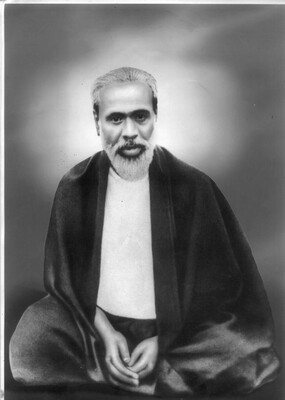
Lalaji Maharaj
1873 — 1931
Sri Ramchandraji Maharaj of Fatehgarh — the Samarth Guru who revived the ancient art of Pranahuti and prepared Babuji Maharaj as the Special Personality. He attained perfection in seven months.
Birth and Early Life
"Great men are not accidentally born, they are born when the world waits for them in eager expectation" said Swami Vivekananda. The power of Nature descended in human form as Samarth Guru Mahatma Ramchandraji Maharaj on the Basant Panchami day in the month of Magha in the year 4974 after the beginning of Kali Yuga, corresponding to the 2nd February 1873 A.D. at Fatehgarh in the state of UP in India.
His father Sri Harbux Rai belonged to a very distinguished family of Kayasths. His great grandfather was given the title of Chowdhari and a jagir comprising 555 villages by the Great Moghul emperor. The family from Bhoomigram in the district of Mainpuri migrated to Fatehgarh after being affected by the aftermath of the 1857 uprising. His father worked as tax superintendent.
His mother was a saintly lady, her heart full of devotion and she was strongly attracted towards God. She had a melodious voice and her recitation of Ram Charit Manas thrilled the audience. Charity was practiced by her to the fullest and no needy person ever left her house without satisfaction. However, she had no children and they had adopted a son.
Once an Avadhoot called at her door. After being served food, he asked for fish. As she was a Vaishnav she found herself unable to provide it, but her maid arranged it from the outer kitchen. After being satisfied, while leaving the house the Avadhoot asked "what ails you?" The maid said the lady has no children. After a few moments, beaming with brightness, raising his fingers towards heaven he said "One... two..." and left. Soon after, the first son Sri Ramchandra was born on 2nd Feb. 1873 and another son Sri Raghubar Dayal was born on 17th Oct. 1875.
Childhood and Spiritual Awakening
Sri Ramchandra, affectionately called Lalaji Saheb, recited Ram Charit Manas for his mother in an uncommonly sweet and melodious voice inherited from her. His mother's spiritual life had a great effect on him and he developed a strong love for Reality from an early age. His mother breathed her last when he was only seven years of age and he was brought up by another woman who loved him dearly.
He was educated in Urdu, Persian, and Arabic by private tutors and learnt Hindi from his mother. He studied at the Mission School at Farukhabad and passed the English Middle Examination. While playing the game of tops with other boys, the whirling motion of the top reminded him of the work for which he was born and since then he took up his spiritual preparation and work. It is the will of God that he attained perfection within a brief span of seven months.
He was married to a noble lady of a respectable family. His father expired soon after his marriage. The Raja of Mainpuri brought action against his ancestral property and he lost everything. His adopted brother also expired around this time. Circumstances forced him to move into a much smaller house. He joined as a paid apprentice at rupees ten per month.
Personality and Daily Life
Lalaji Maharaj was of perfect build, average height, wheatish complexion with a broad high forehead and eyes "like two bright stars." He wore simple kurtas, shirts, pyjamas, dhotis, a waistcoat, buttoned coat, colored cap, and shawl. He kept no ornaments and kept his eyes mostly down. He did not laugh aloud but had a gentle smile.
He was frugal in food habits — no breakfast; bread, pulses and chatni for morning, bread with vegetables and pickles for evening. He never took meat, ice, or tea. His daily schedule was remarkable: he never slept after sunrise, attended to spiritual sadhana and training others, went to office, returned for more training, took early dinner, walked at 8 PM, and continued training aspirants till 2 AM.
Calm by nature, he was deeply moved by others' pain. He spoke sparingly but answered questions exhaustively. He was against rituals, favoured widow marriage and female education. He treated servants like family and disliked backbiters.
Spiritual Work and Teachings
Transferred from Kaimganj to Fatehgarh in 1908, he lived mostly in seclusion, lost in God. Teachers came to him first, then students, then others. His work was "that of a sweeper or washerman" — cleansing people. His motto: "no undesirable should be initiated but if one had come, he must not go back." He hated being called guru; he said he was "only a peon to his officer."
He established regular satsangh from 1914. After retirement in 1929, he devoted all his time to spiritual work, spending 2-3 hours daily dictating books, articles, and letters. He was a scholar of Urdu, Persian, and Arabic, with sound knowledge of Hindi and Sanskrit. He disclosed unknown secrets of the Vedas.
His key teachings:
- "Never offer advice unless invited."
- He never directly asked anyone to give up bad habits — they left naturally. "If you sit by a fire, you feel warm."
- He advised reduction of wants and prohibited intoxicants and adultery.
- He was against idol worship but allowed photos (not worship of them).
- He considered love the greatest tapas and preferred the middle way.
- Meditation on heart was the real sadhana.
Spiritual perfection, he taught, is based on three things: (1) love for Master, (2) satsangh with Master, (3) obedience to Master. Three things are necessary for a saint: (1) permanent bodily ailment, (2) financial stringency, (3) being found fault with.
He spoke of his own afflictions: "Sometimes I had nothing for meals, one quilt with mutilated padding for the entire family," yet "all this was absolutely of no importance to me as compared to Reality."
"God has hidden himself inside our hearts and exposed us. Hide yourselves and expose God!"
Master of Transmission
He was the Master of transmission — the Upanishadic Pranasya Pranah. He brought back the long-forgotten art of Pranahuti. He could bring a man to perfection at a single glance and made perfection possible in one life while living normal family life.
When asked about his representative, he replied: "When the candle shall be lighted, the moths would themselves fly to it" and made the prophetic statement: "Ram Chandra will be the light of the family" (Ram Chandra Chirag-e-khandan hoga).
Maha Samadhi
In 1931, he fell seriously ill, immersed in God. He said: "As the coveted hour of merger with the beloved gets nearer, so increases the fire of desire of him." His final days were marked by illness but complete absorption in the Divine.
On 14th August 1931, he came to the puja room unaided, lay on the bed, and closed his eyes. At 1 AM the light was extinguished — he attained Maha Samadhi.
Babuji Maharaj saw the Master merge with him in a vision: "Man too shudam, too main shudi..." (I became you and you became me). "The greatest miracle of Sri Lalaji is the perfection of Sri Babuji's grand personality which is unparalleled in the history of spiritual development."