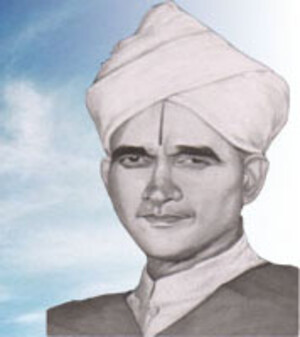
Dr. K.C. Varadachari
1902 — 1971
Professor of Philosophy at Tirupati, Gold Medallist, first Doctorate in Visistadvaita — who found in Sri Ramchandra's system the culmination of his lifelong spiritual seeking. He coined the word 'Imperience' and established the Sahaj Marg Research Institute.
Birth and Family Background
Dr. K.C. Varadachari was born at Munulapudi Agraharam, a small village near Tiruchanoor — the temple town of Sri Padmavathi Ammavaru — on 14th August 1902, in the asterism of Moola and Vrschika Lagna. His father, K.C. Krishnamachari, was a senior police officer in the Madras Presidency, a resident of Tirupati Town belonging to a traditional Sri Vaishnavite family. The family tradition traces its origin to Sriman Nallan Chakravarthy, a close disciple of Srimad Ramanuja of the 11th Century A.D.
He was very dear to his mother Kuppacchi as the only surviving male child. He had two sisters, Rajamma and Sulochana. Known for his belief in God and innocence from childhood, his grandfather would tell him to stand facing the sky with closed eyes and open mouth, promising that God would drop candy into his mouth — and the young believer would stand for quite long before being "rewarded."
Education and Early Influences
He had his school education at the Mahant Hindu High School, Tirupati. He completed his F.A. (Maths, Physics, Chemistry) from Christian College, Madras in 1921. During 1921-1923, he participated in the Non-Cooperation movement. He developed deep interest in religion and philosophy through reading Swami Vivekananda and Sri Aurobindo, recording a profound change in life on 22nd February 1921.
In 1923, he joined B.A.(Hons) Philosophy at Madras Christian College and became a Gold Medallist of the Madras University in 1926. He was much influenced by Professor Hogg, who helped him understand evolutionism and subjective idealism.
He was above average height, very fair complexioned, with a melodious resonating voice. His eyes were sharp and when he looked at others, compassion overflowed from them. From 1945 onwards he wore dhoti with a long coat and a white turban.
Marriage and Freedom Movement
He married in 1926 to Sow. Rukmini (Rajamma) of the distinguished Patrachariars family. His brother-in-law V.K. Narasimhan was active in the Freedom Movement and later became associated with The Hindu newspaper. Varadachari participated in burning foreign articles, the Khadi movement, and was a total Gandhian. He spun the charka and made his own paper. Till the last day of his life he never wasted paper.
Academic Career and Philosophical Development
His first book, "Metaphysics of Ramanuja's Sri Bhashya," was published in 1928. He reviewed books on Philosophy, Psychology, and Religion for The Hindu's Sunday editions for over three decades. He completed his Ph.D. thesis — "Theory of Knowledge of Sri Ramanuja's Sri Bhashya" — in a record 9 months, typing it himself. The PhD was awarded in 1932, making him the first Doctorate in Visistadvaita from Madras University.
His first child Rohini was born on 12th December 1932. Tragically, Rohini died of smallpox on 12th December 1934 — exactly two years later. Sons Aravinda Rajagopal, Srivatsan, and Narayana were born in 1935, 1937, and 1939 respectively.
Seeking the Master
He met Sri Aurobindo in 1937 and sought initiation, but Aurobindo declined, saying another person would initiate him later. He decided to wait for the Master to come to him. He joined as Professor of Comparative Religion and Philosophy at the Sri Venkateswara Oriental Institute, Tirupati.
Significant spiritual experiences followed: revelation of Agni on 19th October 1943, initiation with Prana on 14th March 1944, vision of Maha Kali in March 1944, and deep Samadhi on 24th October 1944. But something deeper was still being sought.
Meeting Sri Ramchandraji Maharaj
The pivotal moment came in 1955. He reviewed Babuji's book "Reality at Dawn" for The Hindu newspaper. Three persons responded, and then Babuji himself wrote, offering to help him in spirituality — the first time someone had come to him rather than the other way around. The Master visited Tirupati in December 1955 and introduced him to the system.
He made extraordinarily rapid spiritual progress: Crossed Pind Desh on 2nd March 1957. Entered Para Brahmand Mandal on 17th May 1957. Finished Para Brahmand journey on 17th August 1957. Entered the Central Region on 30th August 1959. Completed the First Ring of Splendour on 14th February 1960. The Second Ring on 3rd February 1961. Third Ring entered 22nd April 1961, Sayujyata state on 16th August 1961. Fourth Ring on 18th November 1961.
He was made Preceptor in 1957 and granted a position on par with the Master.
Key Contributions to the System
He was the Director of the Sahaj Marg Research Institute (started at Tirupati, 1965). He presented the system as a "New Darshana" in 1966 — the first time any spiritual system called itself a darshana beyond the traditional Shad Darshanas. He coined the word "Imperience" — meditational feelings that are not sensory experiences but awareness of Consciousness per se.
He gave regular Sunday talks at Tirupati on Sri Ramchandra's Raja Yoga (published as Complete Works Vol. I). He spoke on all of the Master's books and wrote the Foreword for "Towards Infinity." He assisted the Master in preparing the Manual of Spiritual Service and suggested the Daya Sakti and Kaal Sakti training methods.
His philosophical understanding was profound: the concept of the Ultimate as Zero, Invertendo (inversion principle), Brahman extending up to our knowledge of it, Saccidananda not being the Ultimate Reality, and the individual being continuous with the Universal and Ultimate.
Personal Trials
His life was marked by extraordinary personal suffering borne with spiritual equanimity. He was consistently ignored for promotions — juniors were promoted as Principals while he was denied. He learned "lessons of disgrace, defeat, demotion."
His daughter Padmini died on 23rd November 1963. His response: "I have had disgrace in profession, disasters in personal life but this threat to honor and now death I never thought would be my portion." To his son Narayana he wrote: "Punishment is for reformation, not retribution... Know all as the gifts of a most benevolent guru — God."
In 1965, while serving as the first Vivekananda Professor at Madras University, he lost his brother-in-law, his uncle, and his wife within weeks of each other.
Final Years and Legacy
His spiritual pinnacle: commenced Laya Avastha in Brahman on 21st January 1968, established 15th February 1968, completed 26th April 1968. He warned against commercialization of the Mission: "Let us not commercialize our Mission in our haste to secure financial stability... We have to imbibe the sense of Mission — Spiritual and not mix it up with other ends."
The Master confirmed his state: "You are in Absolute Reality" (letter dated 21st June 1970). "Nothingness or negation is your condition" (letter dated 24th June 1969).
His last diary entry was a prayer:
"O Master I pray to thee / To forgive me and remove / This last barrier between me and thee / Let my love be complete / And my Non-Being Real! / Let me forgot thy words — / Let the ORGANISATION go as Thou wantest / Who am I, what am I? / Mergence in Thee is All now / Let it be the True Beginning."
After suffering from diabetes since 1961 and approximately one and a half months of final illness, he attained Maha Samadhi on 31st January 1971 — Basanth Panchami, the birth anniversary of Lalaji Maharaj.
The Master wrote to K.C. Narayana: "We have not prayed for his liberation, because it would have been very ridiculous for a man who has already attained liberation and can give the same to others also." He called Dr. KCV "his intimate" — the same term used for Radha and Krishna.
"He was infectious and was carrying with him the seeds of Infinity wherever he went."